A comprehensive overview of the Work: the diagnosis, the machine, the method, and the two laws that govern everything that happens.
The Fourth Way is a century-old system of practical transformation, taught by G. I. Gurdjieff and his students, holding that a human being can awaken from the automatic life — not by retreating to a monastery, an ashram, or a cave, but exactly where they already stand. This site presents its key ideas, freshly stated for a modern reader. Verify everything. Believe nothing.
The Fourth Way begins with a diagnosis, and it asks you to verify it rather than believe it: man is asleep. Not at night — now. The state we call ordinary waking life is a kind of dreaming with the eyes open: thoughts think themselves, moods arrive uninvited, and hours pass on autopilot. You have driven a familiar road and arrived with no memory of driving. That gap — between being conscious and merely being functional — is the whole subject of the Work.
The tradition's claim is stronger than "people are distracted." It says the feeling of a single, continuous, in-command I is itself part of the dream — and that a different state, self-remembering, is available in which attention flows in two directions at once: outward to the world and inward to the one attending. Moments of it happen accidentally in every life. The Work is the craft of producing them on purpose.
Every great tradition already knows this. Judaism's kavanah and halakhah, Christianity's "watch and pray," Islam's muraqabah and remembrance, Buddhism's sati, the Gita's action-with-presence — each names the sleep and commands the waking.
The three classical paths of transformation — fakir, monk, and yogi — are specialized methods. Each full-time method demands leaving ordinary life. The Fourth Way makes a different wager: that ordinary life itself — your job, your family, your inbox — can be the monastery, if you know the method. Nothing here is to be believed. Everything is to be tested.
In the book: Chapters 1–3, with the full survey of the traditions and the three-part test for verifying the diagnosis in your own experience
Part II — The Machine
Know the Machine Before You Drive It
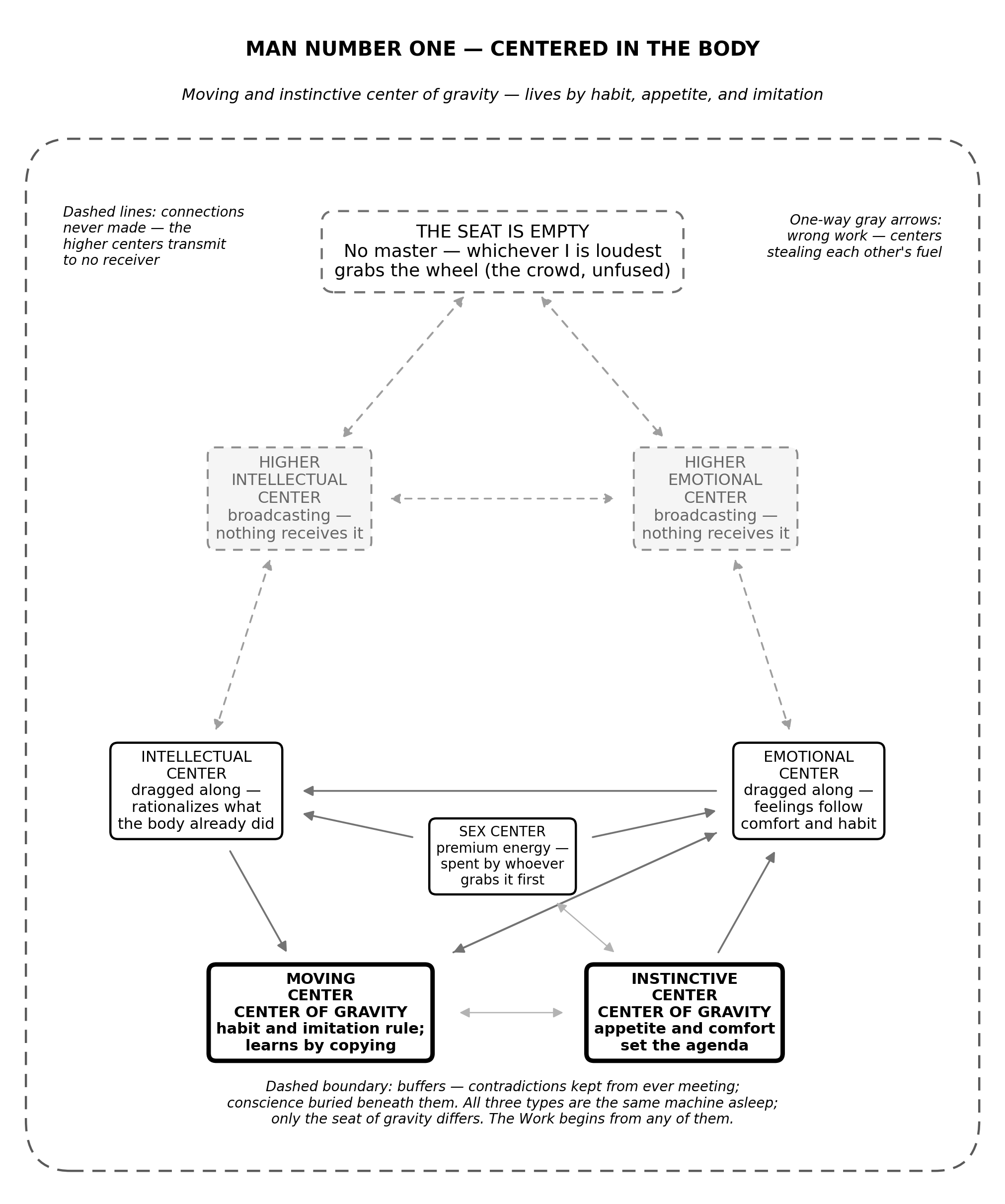
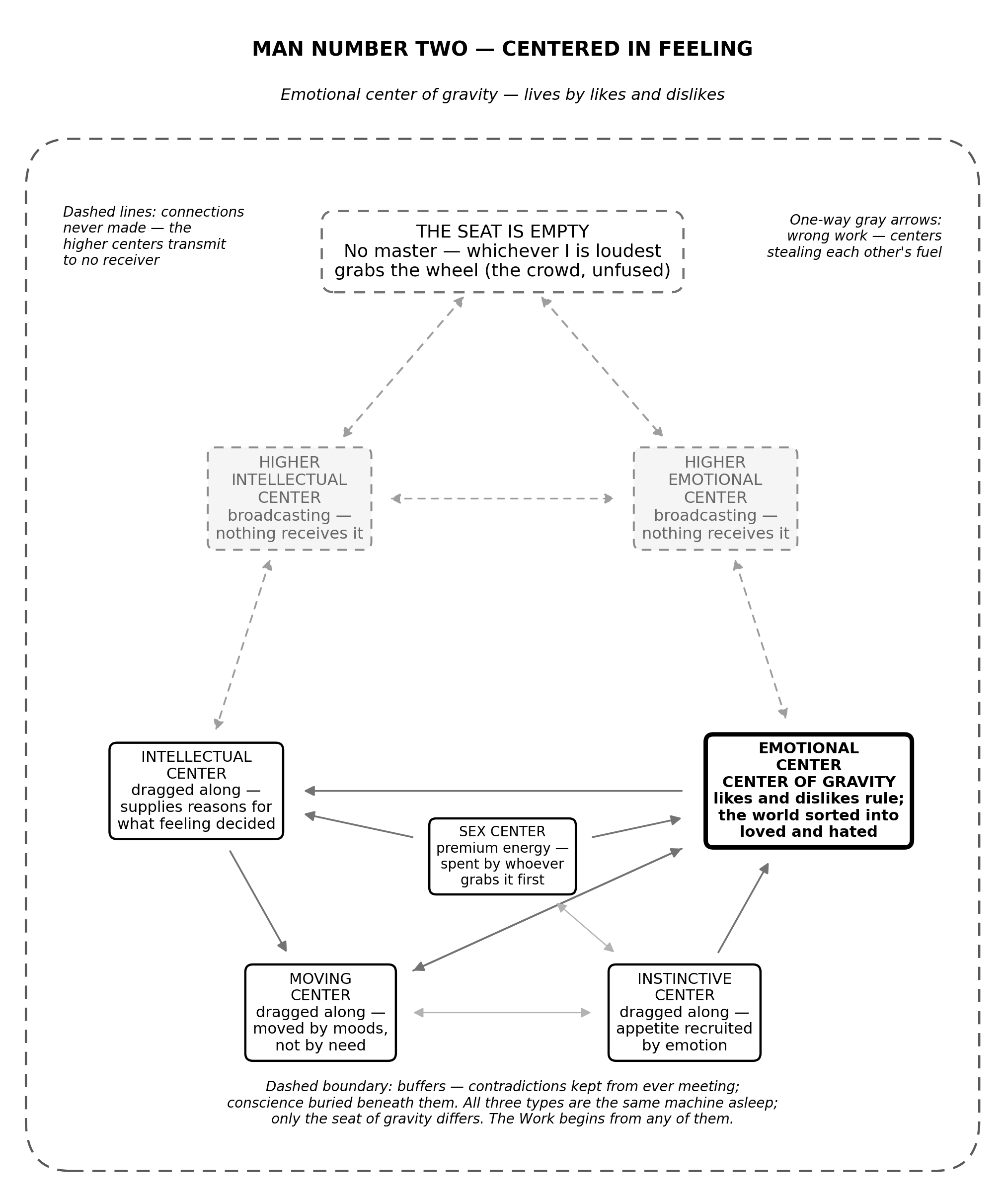
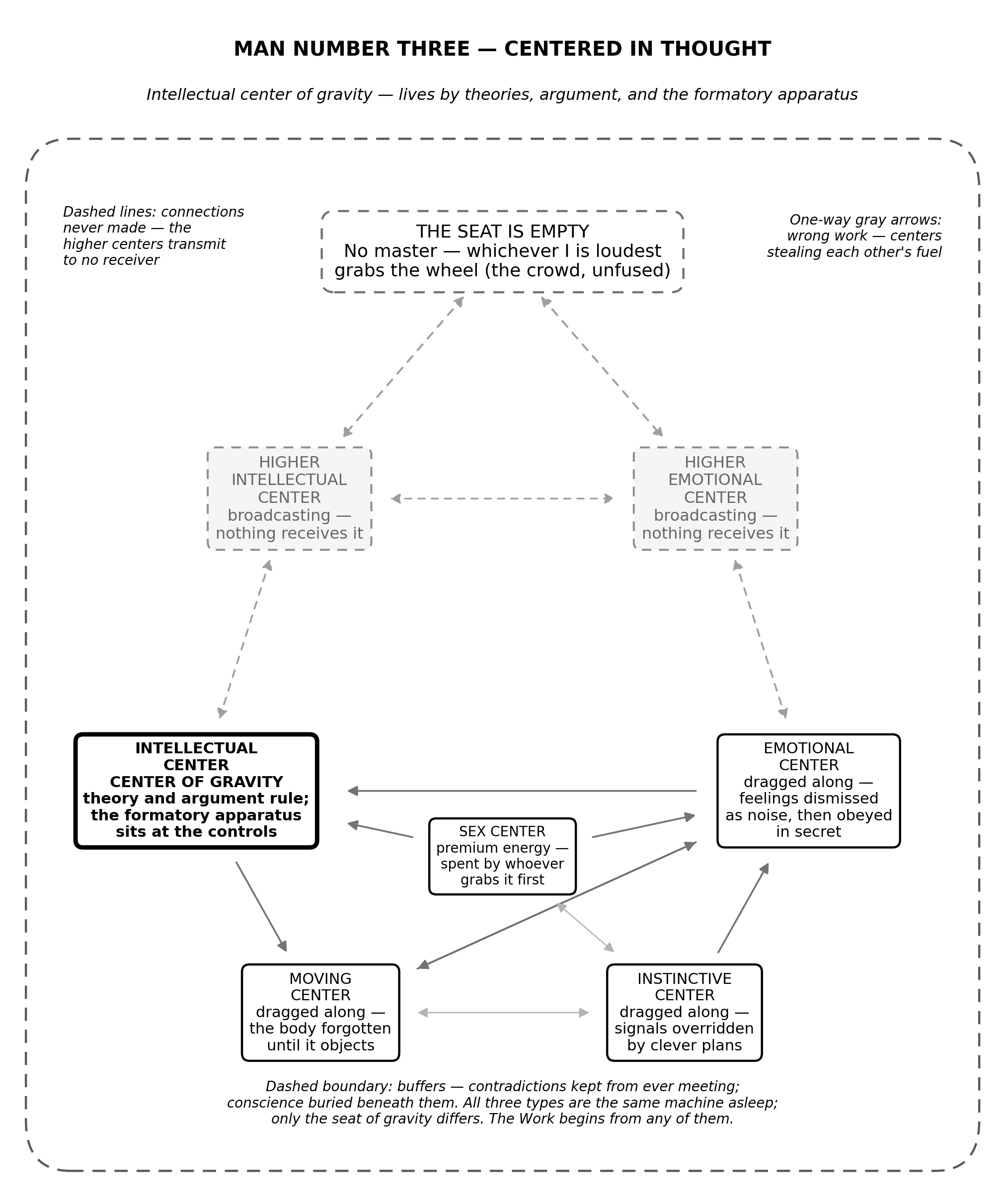
What runs your life on autopilot is not a defect — it is a very capable machine. The Work's map of it has five lower centers, each an independent mind with its own speed and its own fuel: intellectual, emotional, moving, instinctive, and sex. Most inner chaos is wrong work of centers — thinking doing feeling's job, emotion hijacking the body, every center stealing fuel that isn't its own. Two higher centers broadcast continuously; in sleep, nothing receives them.
Look closer and the single "I" dissolves into a crowd of I's — hundreds of small selves, each grabbing the wheel for a moment and calling itself you. What keeps the crowd from noticing its own contradictions are buffers — psychological shock absorbers that keep the lie comfortable. Beneath them lies conscience: not learned morality, but the felt truth of the whole being at once. The classic image holds the anatomy together: a carriage (body), horse (emotion), driver (mind) — and an empty seat where the master should sit. A century later the rig updates itself: a self-driving car — vehicle for body, battery for emotions, and for the mind the computer systems that run the autopilot and navigation — software trained on millions of miles of other people's driving. It glides through traffic flawlessly and circles the same streets all day, because the one field the car cannot fill by itself is Destination — and the only one authorized to enter it, the owner, is asleep in the back seat. The master isn't missing; he's aboard, sleeping through a ride that was never once his. (One honest note: on emotions, the old image keeps the better psychology — a battery drains and charges, but a horse wants.)
The Ladder: Man Number One Through Seven
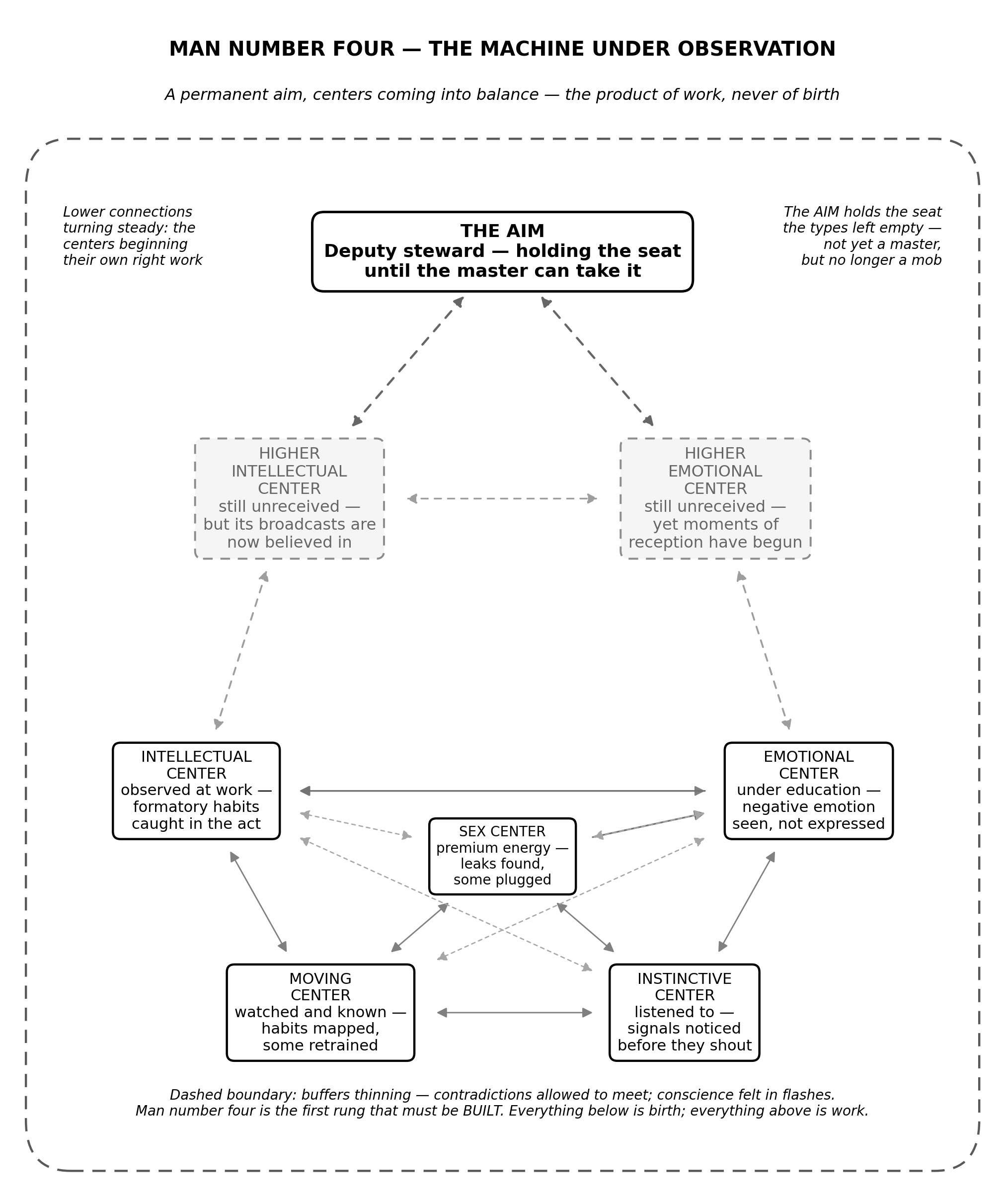
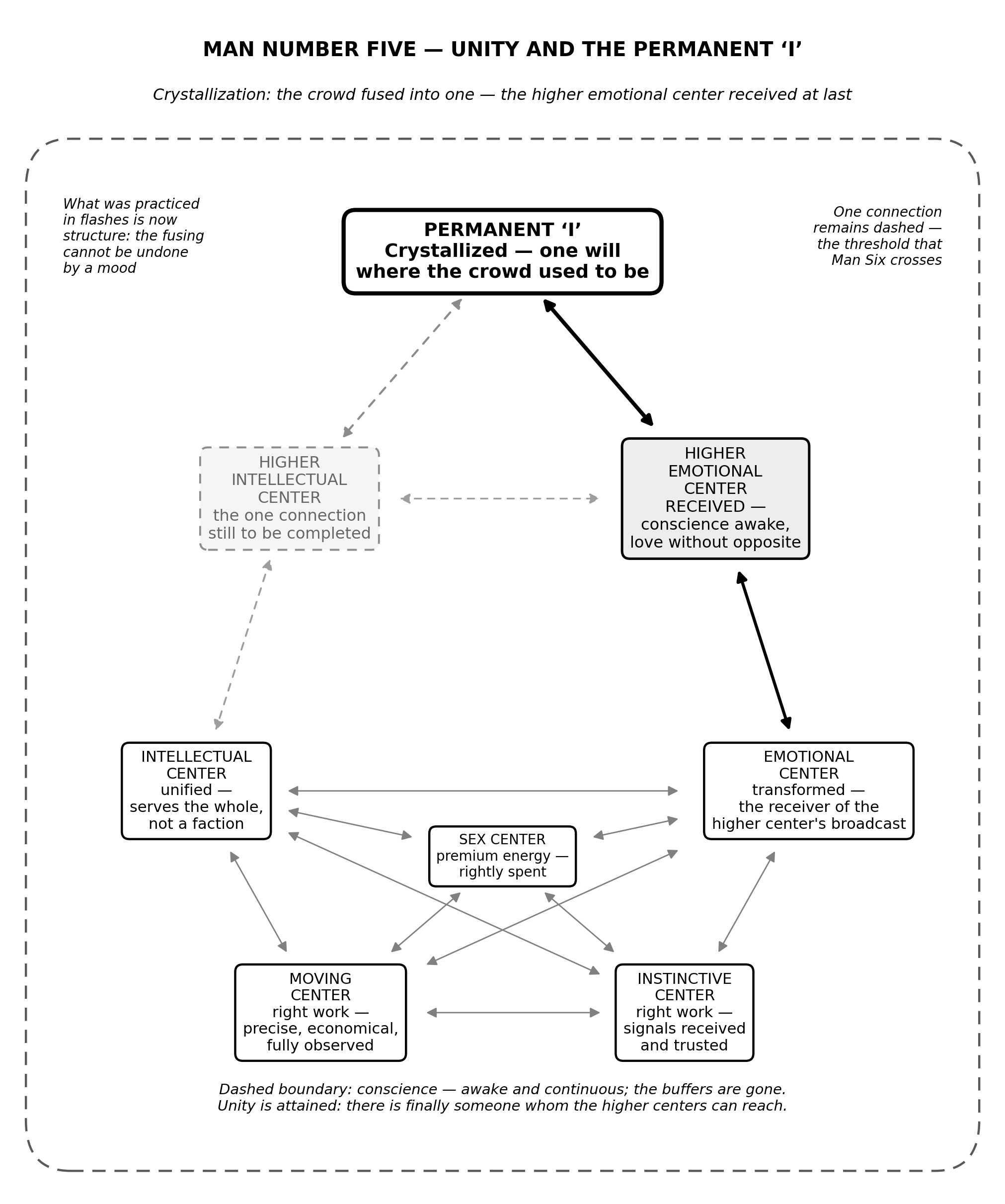
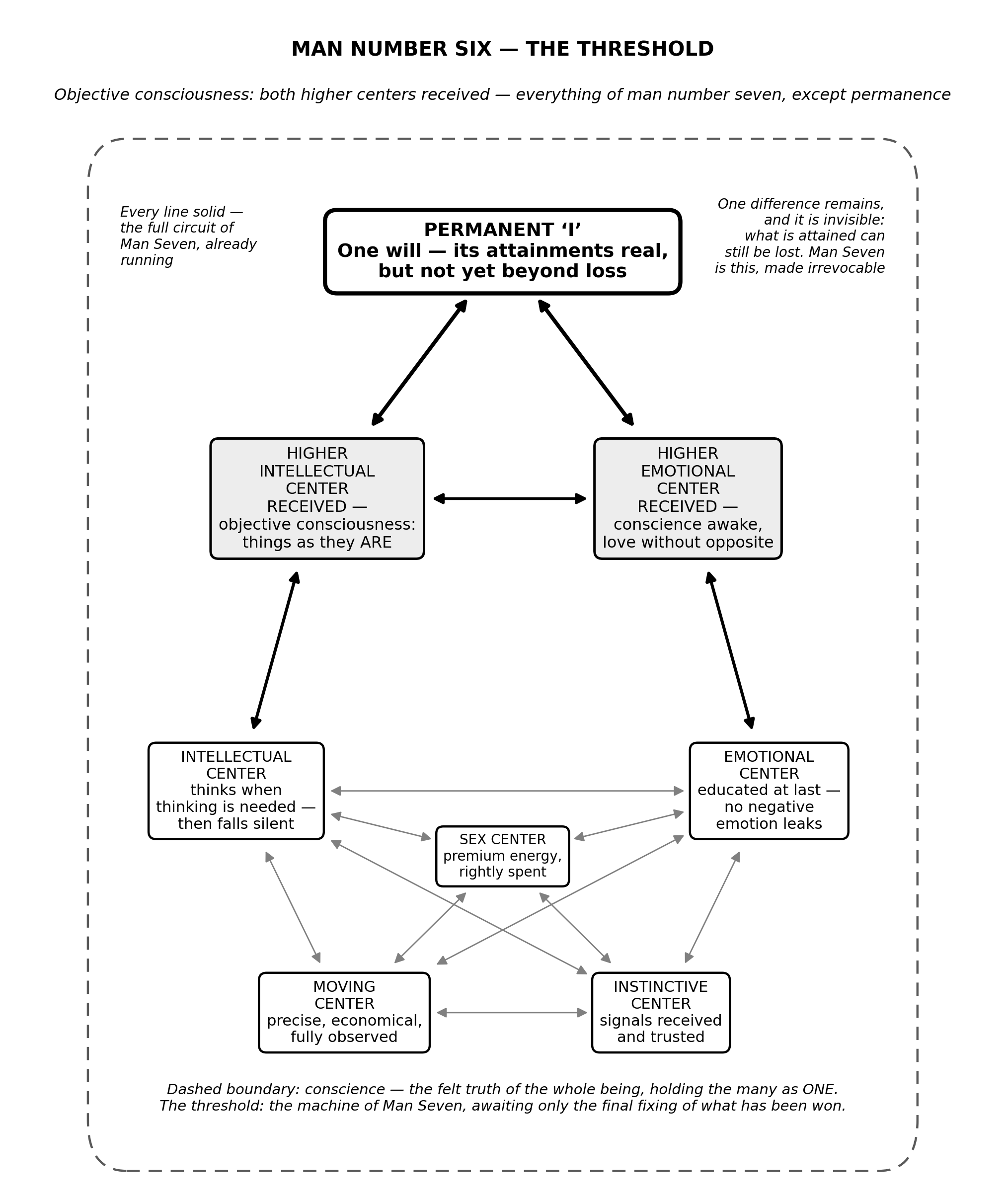
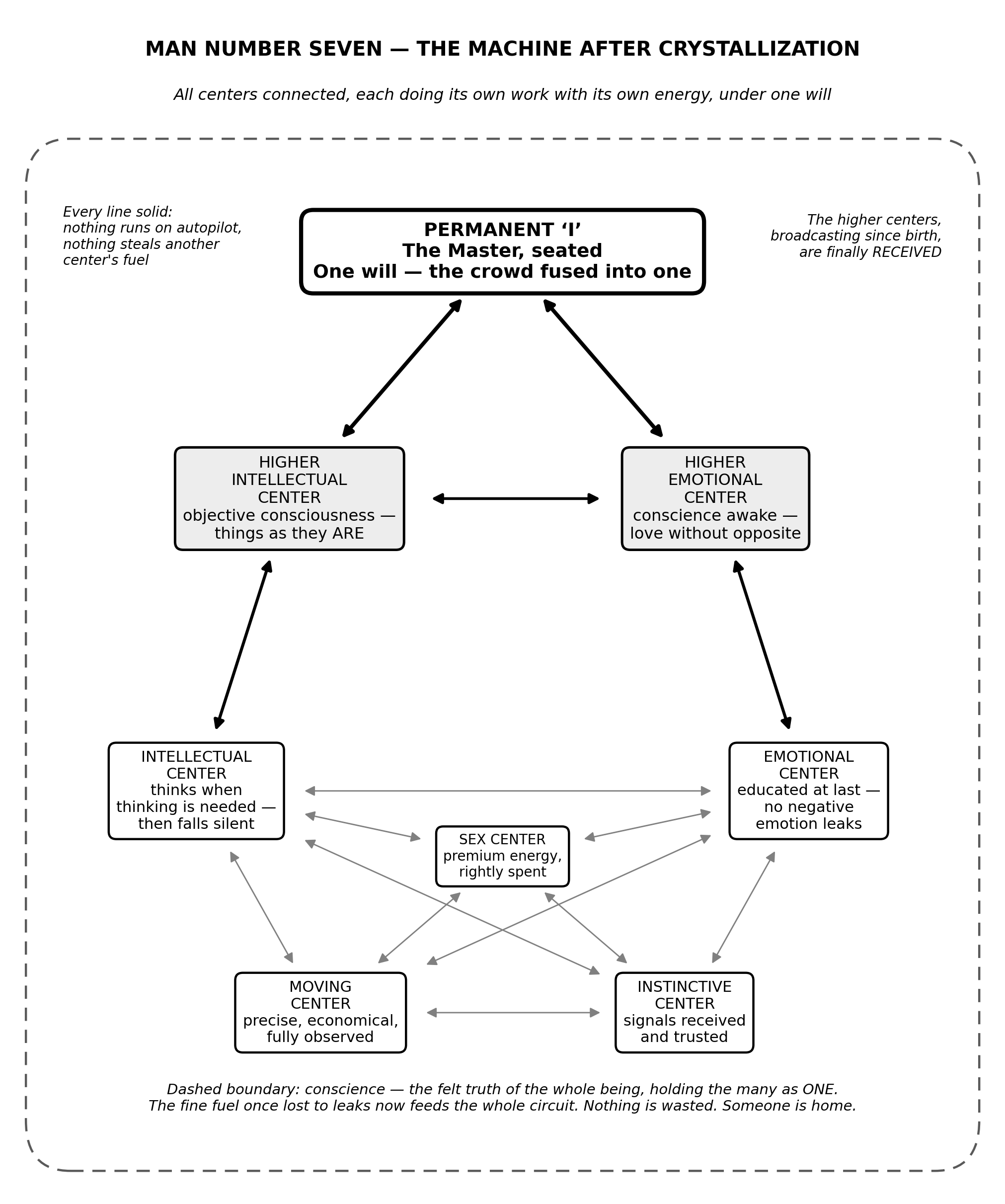
Everyone is born one of three types — centered in the body, in feeling, or in thought (man number one, two, and three). These differ only in flavor; all three are the same machine asleep. Man number four is the first rung that must be built: a permanent aim, centers coming into balance, a deputy steward holding the empty seat. Above that: unity (five), the threshold (six), and the completed machine under one will (seven). The seven diagrams below share one frame — what changes, rung to rung, is not the machine but its connections.
Man 1 — centered in the bodyMan 2 — centered in feelingMan 3 — centered in thoughtMan 4 — the machine under observationMan 5 — unity and the permanent IMan 6 — the thresholdMan 7 — the machine after crystallization
In the book: Chapters 4–9 — including the parts of centers, chief feature, and the full education of the emotional center
Part III — Core Practices
The Method, Hour by Hour
Self-observation comes first, and it has an iron rule: observe before you change anything. You cannot repair a machine you have never watched run. Then the central practice: self-remembering — divided attention, awareness of the world AND of yourself, both at once. Ten seconds of it is real. The machine cannot do it; that is precisely why it works.
Understand what actually changes, because it is not the presence of awareness — awareness is always present. What changes is the shape of its flow. Ordinary attention moves like an arrow, or a river: one direction, out, spent entirely at its target. In self-remembering the flow becomes circular — a whirlpool — still touching the world, more vividly than before, but curving back through the one who touches: nothing divided, one current bent into a circle. And the real state has a taste you can learn: the counterfeit announces itself in words, while the real thing shifts something — a slight, unmistakable clarity that grows if you stay. The state will be lost, again and again; finding your way back — again, and again, and again — is not failure. It is the practice itself, wearing the channel that one day carries its own current. Even the effort has a horizon: what is practiced long enough becomes structure, and what once cost everything eventually costs nothing. Meanwhile, tend the instrument — a tired or hungry body drags every arrow to itself. Sometimes the most spiritual thing you can do is take the nap.
The Work names four states of consciousness: sleep in bed, so-called waking sleep (ordinary life), self-consciousness (self-remembering sustained), and objective consciousness. Most lives are spent entirely in the second. The practices aim at the third — and the third opens the door to the fourth.
Two further fronts: the body — posture, tension, breath — as the most honest instrument on the panel and the anchor for attention; and the emotions, where the Work makes its most counter-cultural demand: the non-expression of negative emotions — not suppression, but declining to feed the leak while observing it, because negative emotion is the machine's single largest energy hemorrhage.
In the book: Chapters 10–12, each ending in graduated practices — plus the complete toolkit of Chapter 17
Part IV — The Laws
The Law of Three: Nothing Happens Without a Third Force
Every event — every one — is the meeting of three forces: active (the push), passive (the resistance), and a neutralizing third force that brings them into working relation. Two forces alone produce only stalemate; this is why resolutions fail and why willpower loses to habit. The practical art is learning to see the third force — and to supply it when a stuck process needs one.
Event
Active force
Passive force
Neutralizing (third) force
A seed becomes a plant
Sunlight and water, driving growth
The seed itself — dormant, inert, resisting change
The soil: the medium that holds moisture to the root and warmth to the germ, letting energy and seed combine
Bread rises
The yeast, actively fermenting
The dough — heavy, dense, going nowhere on its own
The warmth of the proofing place, which brings yeast and dough into working relation
An argument gets resolved
One person pushing for change
The other's resistance to it
The shared commitment (the marriage, the friendship, the project) for whose sake both sides bend
A sale closes
The seller's offer and pitch
The buyer's hesitation and inertia
The buyer's actual need, which relates the offer to the hesitation and tips it
A student learns to drive
The instructor's guidance
The student's fear and untrained habits
The empty parking lot — safe conditions in which instruction can meet fear without disaster
A new habit takes hold
Your intention
The machine's inertia
The technique: the alarm clock, the calendar entry, the partner — structure that relates intention to inertia (this whole book is a study of this row)
In the book: Chapter 12, with the six triads and how to work with each
Part IV — The Laws
The Law of Octaves: Why Everything That Starts, Stops
No process moves in a straight line. Every development proceeds like a musical scale — do, re, mi… — and at two precise places the energy of the original impulse runs out: the intervals. At the first interval (mi–fa), projects quietly die; at the second (si–do), they die within sight of completion. Nothing is wrong with you when this happens. It is law.
What crosses an interval is a shock — fresh force from outside the line of the process. The first shock must arrive when the interval falls; the second must be placed in advance, prepared before it is needed. Learn where your octaves are, and you stop blaming your character for what is actually structure:
Process (its do)
When the first interval falls
How you'd recognize it
The first conscious shock
Digestion of food (do: food enters the mouth)
Mid-process, when food's refinement reaches mi and can go no further on its own
You don't — and that's the lesson: nothing stalls, because the shock is automatic
None needed: AIR, entering with every breath, crosses this gap for you — nature's pre-installed shock
Work on oneself (do: the aim sentence, day one)
Week three, almost to the day
Not wanting to; the notebook goes blank; a different I is at the controls than the one that promised
The pre-placed week-three check-in call, and re-reading Chapter 1 with the aim sentence in hand
Preparing a meal (do: the menu is decided)
The handoff from raw preparation to actual cooking
Ingredients sit chopped and waiting; momentum dies in the gap between prep and fire
Heat, applied on schedule: the stove lit at the planned time — new energy of a different kind than chopping
Learning the guitar (do: the first lesson)
Weeks two to three, when fingertips hurt and every chord buzzes
"I'll practice tomorrow"; the guitar stays in its case; buying gear replaces playing
The standing weekly lesson (a teacher expecting you) and practice chained to an existing daily habit
Writing a book (do: the premise and first chapter)
Around a fifth of the way in, when the outline's glamour is spent
Endless research; a seductive NEW book idea; rereading instead of writing
A fixed daily writing appointment, plus one reader who expects pages every week
Getting fit — couch to 5K (do: registering for the race)
Week three: sore, tired, and no visible change
The snooze button wins; "rest days" multiply; the shoes migrate to the closet
A running partner waiting at the corner at 6 a.m. — scheduled before week one began
Process
When the second interval falls
How you'd recognize it
The second conscious shock
Digestion of food
At the finest stage: impressions arrive as food but die on contact without attention
Days that leave no trace; meals eaten but never tasted; a life not received
Receiving the impression at its entry — presence at the moment of contact (Chapter 16 teaches this as the Work's central act)
Work on oneself
Months ten to eleven of year one: the completion gap
Coasting; the review skipped because "the year's basically done"; harvest left ungathered
The annual review on the calendar, third-line service, and deliberate deepening of the strongest practice
Preparing a meal
The final half hour, when everything must land at once — and then the meal must actually reach the table
The urge to serve it "close enough"; plating abandoned; the cook eats standing up, alone
The finishing timeline written in advance, and the table set and guests seated BEFORE the final push — completion means eaten, not cooked
Learning the guitar
The long plateau before whole songs: you can play parts of everything, all of nothing
Noodling the same riffs; "good enough for the campfire"; nothing new attempted
A performance date booked and announced — one song brought to completion standard for real listeners
Writing a book
The last tenth: revision and the ending
"It's basically done" (it isn't); tinkering with chapter one instead of finishing chapter twenty
A deadline with teeth: the editor's date, the announced publication, the manuscript promised to a reader
Getting fit — couch to 5K
The final two weeks before the race, and the last kilometer of it
Skipping the last long runs; "I've already proven the point"
The race paid for and public; friends at the finish line; crossing it as a completed act, not a fade
In the book: Chapters 13–14 — including inner octaves and the discipline of finishing
Part IV — The Laws
The Enneagram: The Two Laws in One Figure
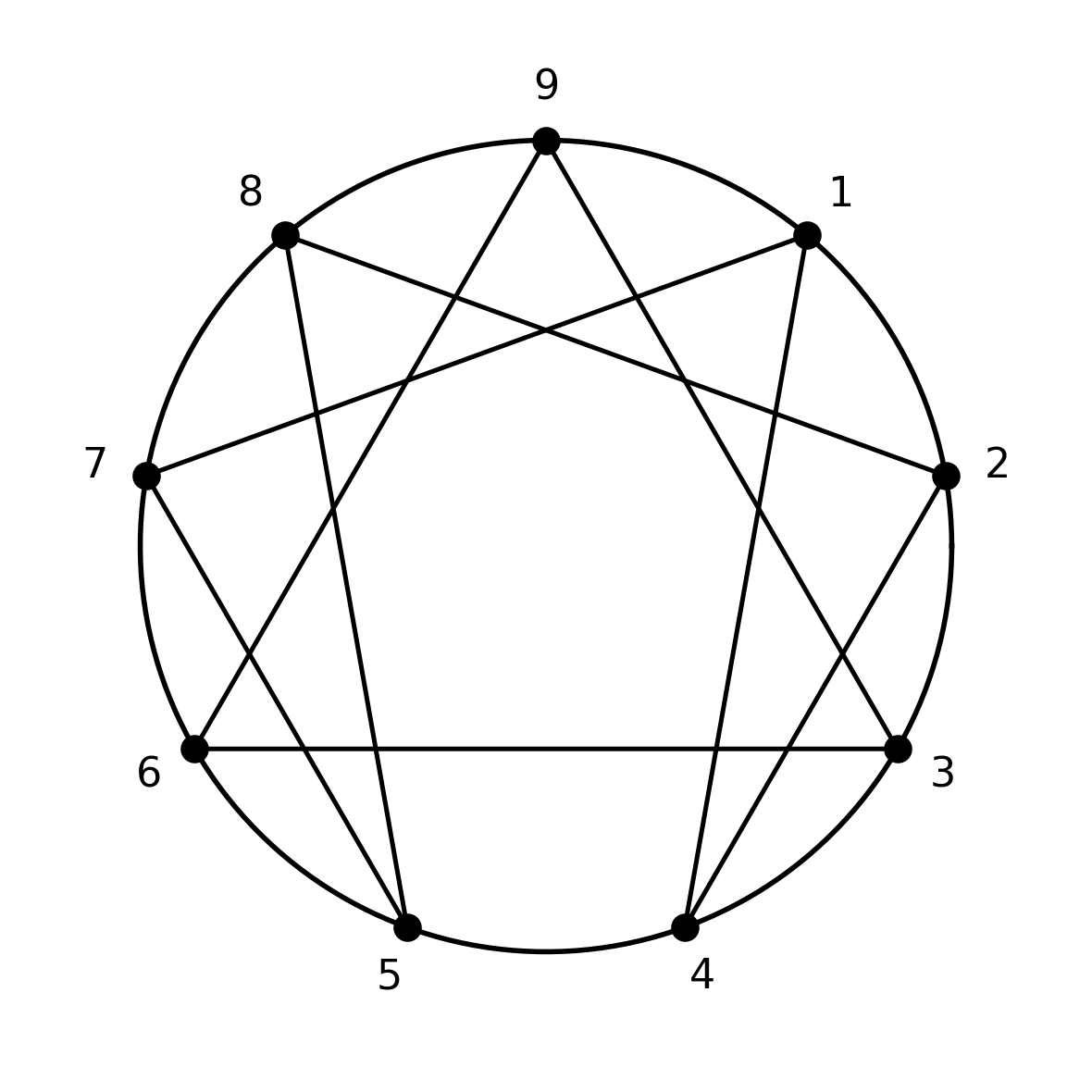
The enneagram unites both laws in a single symbol: a circle of nine points (the octave), an inner triangle at 9-3-6 (the three forces — its points marking exactly where the shocks must enter), and a six-pointed hexad tracing 1→4→2→8→5→7 (the hidden circulation inside any living process). It is not a personality test. It is a map of how anything that happens, happens.
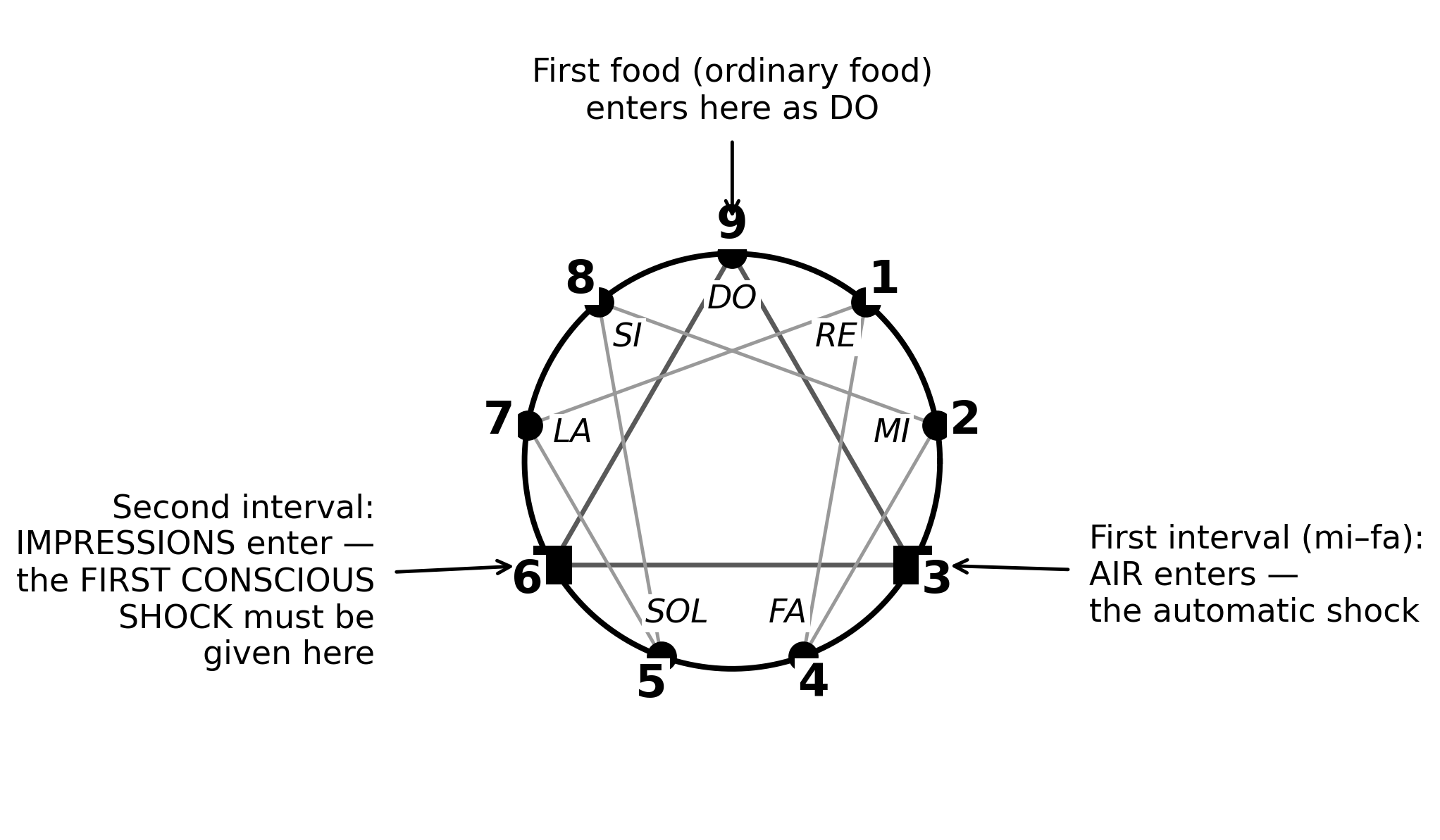
The enneagram: circle, triangle, and hexadThe food octave on the enneagram — the figure's classic worked example
Process
The interval at point 3: when, and how recognized
The first conscious shock applied there
Digestion of food
Food's refinement reaches mi (point 2) and stalls before fa (point 4) — though you never feel the stall
AIR enters at point 3 automatically with every breath: the figure shows nature's shock installed exactly where the structure demands it
Work on oneself
Week three: the launching I is gone, and the one on duty never signed the aim sentence
The check-in call and the re-read — placed at point 3 on day one, which is what "reading your position on the figure" means in practice
Preparing a meal
Prep complete, cooking not begun: chopped ingredients cooling on the board while momentum dies
Fire, on schedule — the stove lit at the planned moment brings energy of a NEW kind, which is what every point-3 shock is
Learning the guitar
Weeks two to three: sore fingers, buzzing chords, the case staying closed
The weekly lesson: a teacher standing at point 3, expecting you — third force wearing a human face
Writing a book
A fifth of the way in: the outline's glamour spent, research spiraling
The fixed writing appointment and the weekly reader — appetite replaced by structure at exactly the marked position
The partner at the corner at 6 a.m., arranged before week one — a shock waiting at its station
Process
The interval between 8 and 9: when, and how recognized
The second conscious shock, introduced at point 6
Digestion of food
Impressions (the finest food) arrive but die unreceived; the octave cannot complete into presence
Attention at the moment of contact — the first conscious shock of Chapter 16, shown on the figure at point 6, prepared long before the completion gap it serves
Work on oneself
Months ten to eleven: coasting, the harvest ungathered, "basically done"
The annual review, the service, the deepening — all scheduled back at mid-year (point 6), which is why the toolkit places them in the program before you need them
Preparing a meal
The cooked meal is not yet the EATEN meal: the final push, and the handoff to the table
The dining room readied at point 6 — table set, guests seated, timeline written — so that when the kitchen's octave ends, the meal crosses to its completion instead of dying on the counter (this is Bennett's famous kitchen reading)
Learning the guitar
The plateau before whole songs: parts of everything, all of nothing
The performance date — booked months early (point 6), so the completion energy exists before the completion gap
Writing a book
The last tenth: the ending unwritten while chapter one gets re-polished
The editor's deadline and announced date, agreed at point 6, when finishing still felt far away
Getting fit (couch to 5K)
The final two weeks and the last kilometer
Race paid, public, friends at the finish — commitments made mid-training that stand waiting at the gap
Process
Reading the inner lines
Digestion of food
Each food's refinement (1→4) enables the next food's entry to matter; how impressions land (2→8) is shaped by the state of the coarser octaves; and the completed digestion (7→1) sets the machine's starting state for the next intake — the refinery is one system, not three pipes
Work on oneself
Early observation (1) is done FOR the sake of the practices at 4; what the practices reveal (4→2) revises the observation; the aim (2) is written with the year's completion (8) in view; the annual review (8→5) reshapes mid-year work; and the finished year (7→1) becomes the raw material of next year's do — the spiral, drawn
Preparing a meal
Shopping (1) is done with the cooking method (4) in mind; the cooking (4→2) revises the plan; the menu (2) is designed from the finished plate (8) backward; serving time (8→5) dictates the coordination of the burners; coordination (5→7) shapes final assembly; and tonight's served meal (7→1) informs the next menu
Learning the guitar
Finger exercises (1) exist for the songs (4); playing songs (4→2) reveals which exercises were missing; the practice plan (2) is built from the recital (8) backward; the performance (8→5) disciplines the daily session; and each completed song (7→1) resets technique one level higher
Writing a book
Research (1) serves the drafting (4); drafting (4→2) reveals what the outline (2) should have been; the outline is written from the ending (8) backward; the deadline (8→5) disciplines the daily pages; and the finished draft (7→1) teaches you how to research the next one
Getting fit
Early runs (1) exist for the training plan (4); training (4→2) recalibrates the goal pace (2); the goal is set from race day (8) backward; the race (8→5) gives every ordinary Tuesday run its meaning; and crossing the line (7→1) becomes the fitness baseline the next cycle starts from
The Living Enneagram
The flat figure is really the top-down view of a spiral: do never returns to where it began — it arrives one level up. The animation below shows all three movements at once: the octave climbing the spiral, the Law of Three ascending its triangle in unison, and the inner circulation racing ahead and returning, always meeting the process exactly on time. Drag to tilt — fully upright, the spiral collapses into the familiar flat enneagram.
In the book: Chapters 15–16 — reading the figure, and the transformation of energies mapped on it
Part V — Transformation
Three Foods, and the Shock Only You Can Give
The machine runs on three foods: what you eat, the air you breathe — and impressions, everything that enters through the senses. The third food is the one nobody audits, and in the modern world it has become industrial sludge: engineered feeds, engagement bait, ambient noise. The Work's claim is exact: the quality of your consciousness is downstream of the quality of your impressions. And unlike the other two foods, this one never pauses: you can fast from food for weeks and from air for minutes, but the stream of impressions runs as long as you live — starve it and the mind simply prints its own. The only impression-free state is death, which makes this the one doorway where presence can always be applied.
And here the octave teaching turns personal. Impressions arrive at the machine as a do that ordinarily goes nowhere — unless a shock is applied at the precise point of entry. That shock is self-remembering at the moment of impression: the first conscious shock. Received awake, the same sight, the same face, the same street delivers finer energy — the fuel every higher process requires. This is why presence is not a luxury. It is metabolism.
In the book: Chapters 16–17 — the full energy ladder, the impression diet, and the complete practice program: first day, first week, first month, first year
Part VI — Living the Work
Friction, Suffering, and the Second Shock
It begins with the most ordinary thing in the world: conscious labor. When there is work that needs to be done, we do it — consciously. The dogs at six in the morning, the dishes, the commute, the inbox: the work still has to happen, and the only question is whether anyone is there for it. A life is mostly made of work, and done this way, the work becomes the Work.
The Work does not promise a smoother life; it promises that nothing in your life need be wasted. Difficulty becomes conscious suffering — suffering met with presence instead of identification — and the very frictions that once drained you become fuel. The person who irritates you is, precisely, your gymnasium.
The second conscious shock works at the moment negative emotion arises: instead of expressing it or suppressing it, the energy itself is transformed — caught at the instant of arising and converted, the single most advanced practice in the canon. Around it: external considering (genuine attention to others), the repair of relationships as Work material, and aim held over years, not weekends.
In the book: Chapters 18–20 — conscious labor, suffering, and the full mechanics of both shocks, with the practices that train them
Part VII — The Edge of the Map
Where Effort Meets Its Limit
Everything to this point is effort — rightly so: the Work is called work. But the map has an edge. There comes a place where effort itself becomes the obstacle, where the doer who has been doing all this practice is seen through, and where what you have been seeking turns out to be what has been looking all along. The tradition knows this territory; the deepest voices of every tradition converge on it.
The book's final part — Part VIII — walks past this edge: what you actually are, the two streams of the world's wisdom flowing together, and why, at the end of all the climbing, there was never anywhere to go. It is the destination the seven parts above were quietly preparing you for — and it is not summarized here, because it should not be met in summary.
In the book: Chapter 21, and the direct path of Part VIII, Chapters 22–26
The Whole Journey
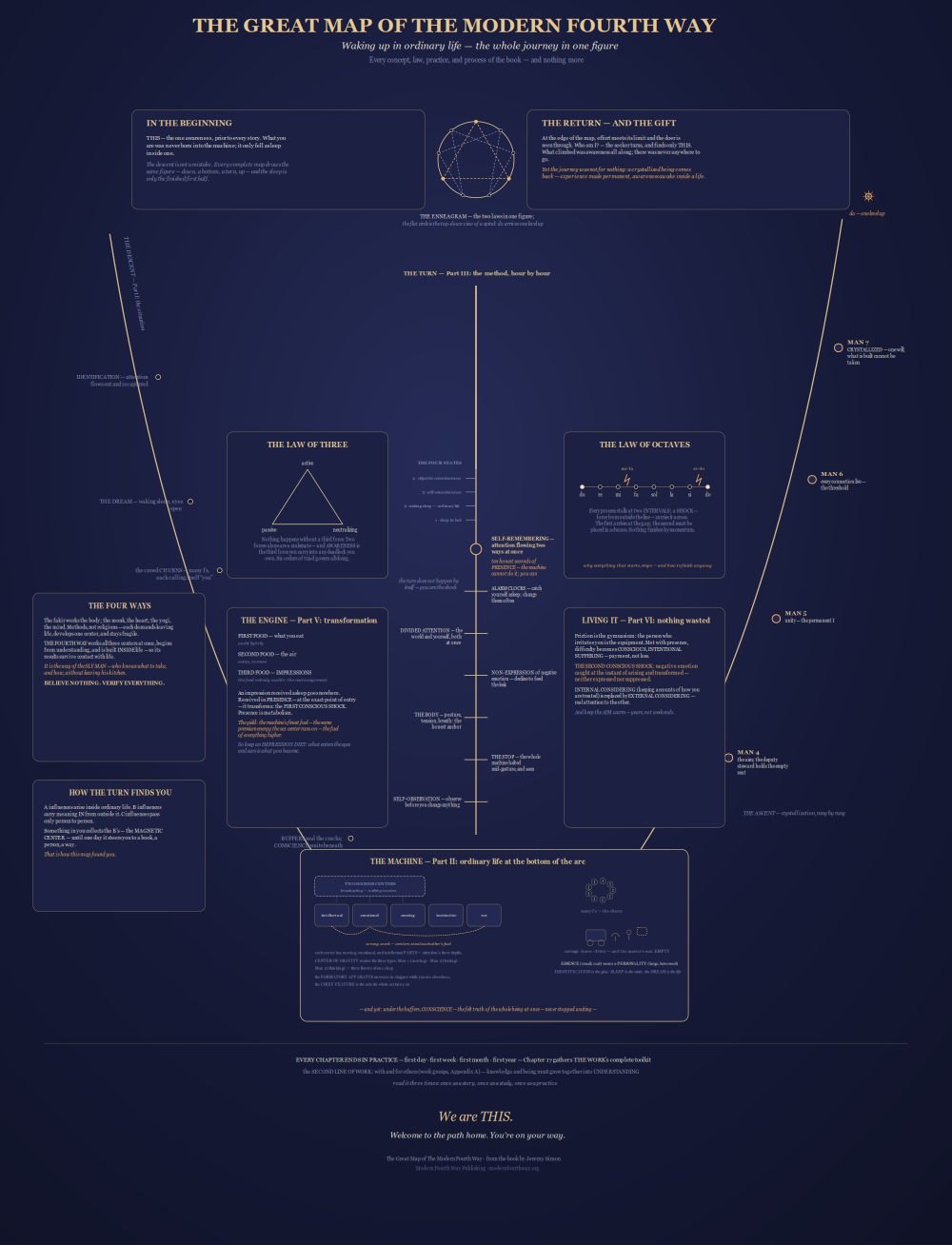
The Great Map of The Modern Fourth Way
Every concept, law, practice, and process of the book, drawn as one figure: the descent into sleep, the machine at the bottom of the arc, the turn, the ladder of practice, the two laws, the climb through Man 4 to Man 7 — and the return, with its gift. A pure vector chart: zoom in as far as you like and every line stays sharp.
Tap the map to open the interactive viewer — pan, pinch, zoom without limit
A Practical Workbook for Waking Up — and Discovering What You Actually Are
Everything on this page is the overview. The book is the practice: twenty-six chapters across eight parts, every chapter ending in graduated exercises — first day, first week, first month, first year — plus the complete toolkit, nine original diagrams, the full teaching of the two laws with worked examples, a 47-term glossary keyed to the page where each idea is first taught, and the final part this site deliberately leaves for the book itself.
By Jeremy Simon · Modern Fourth Way Publishing
eBook — $19.99 · EPUB, instant download · opens in Apple Books, Kindle (Send to Kindle), Kobo, and every standard reader
Read the complete first chapter free, on any device, and get the full-resolution Great Map of the whole path. Then a few short notes over two weeks — one practice at a time — plus occasional news: new writing, the audiobook’s release, and first word of upcoming gatherings.